How long does a heat pump take to heat water?

The last thing you want is a long wait for the office showers or bathroom taps to warm up. So, if you’re considering switching your boiler for a commercial heat pump, you probably have one question at the front of your mind…
How long does a heat pump take to heat water?
Contrary to what you might have heard, heat pumps are highly effective at providing domestic hot water (DHW). And luckily, with a well-designed system, you’ll be able to enjoy it as soon as you turn on a tap.
Here’s the lowdown.
Do heat pumps heat water?
Yes, heat pumps can heat water – it’s all about choosing the right heat pump for your needs.
While some heat pumps are only designed to heat water up to around 60°C, others are capable of heating water to significantly higher temperatures.
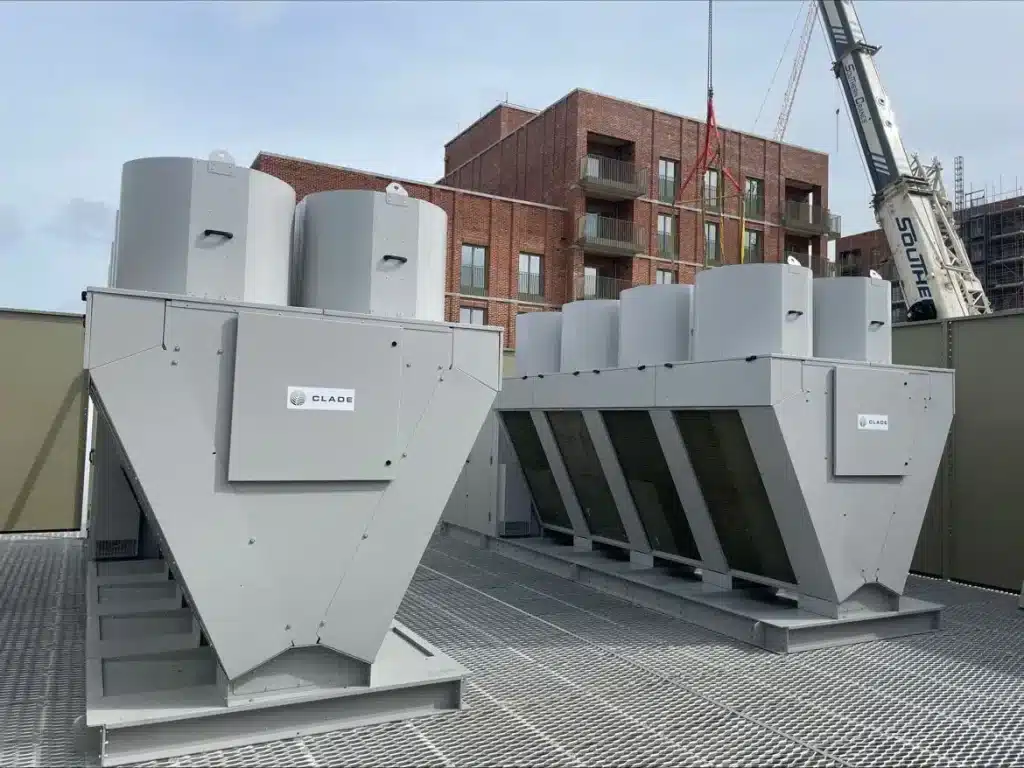
For instance, our CO2 heat pumps and groundbreaking R290 Elm heat pump have consistently proven that they can produce a reliable hot water supply at 80°C, even with variable ambient conditions. This is more than enough for most hot water requirements.
You can install a domestic hot water heat pump as a standalone water heating system, meaning your heat pump will only provide hot water for your building. Or, you can install it as a combination water heating and space conditioning system, meaning it will provide your building with space heating and domestic hot water for 100% heat decarbonisation.
Either way, the average air source heat pump is around 300% efficient, compared to the most efficient gas boilers, which are only around 98% efficient. So, a heat pump is certainly an effective way to meet your DHW requirements.
How do heat pumps heat water?
Heat pumps work by moving heat from one place to another, rather than generating heat from scratch.
Air source heat pumps extract warmth from the air, using an extractor. This is then passed to a compressor, where the temperature and pressure are increased using a small amount of electricity.
Next, the heat energy passes to a heat exchanger, where it’s transferred to whatever you want it to warm – in this case, your mains water supply, which circulates to taps and showers.
Hot water is generally stored in a hot water cylinder, where it can be sent straight to taps in the building once they’re turned on to provide instant hot water without any waiting required.
How long does a heat pump take to heat water?
It’s difficult to say exactly how long a heat pump takes to heat water, as this depends on lots of different factors. These include:
- Heat pump capacity. The higher the wattage of your heat pump, the more powerful it will be and the quicker it will heat water. However, larger heat pumps are usually paired with larger cylinders, which brings us onto…
- Cylinder size. The larger the size of your hot water cylinder, the longer it will take to heat from cold.
- Target temperature. Hot water should be stored or pasteurised at 60°C or higher to kill bacteria. The higher the target temperature, the longer it will take to heat. Instantaneous hot water can be much lower temperatures because it is not stored.
- Heat pump efficiency. More efficient heat pumps will work faster to heat water than less efficient models. Heat pump efficiency can vary based on factors like refrigerant and system design.
- Ambient temperatures. The colder the temperature of the air outside, the harder your air source heat pump will need to work to convert it to the required flow temperature, and the longer it will take.
Important: The time it takes to heat your domestic water isn’t the same as how long you have to wait once you turn the tap on.
On the contrary, DHW heat pumps are usually paired with a hot water cylinder.
Here, hot water is stored ready to be sent straight to your taps when they’re turned on.
This means you shouldn’t ever be left waiting for water to heat up, unless you use more than what’s stored in your hot water cylinder.
A good system designer should prevent this from happening by sizing your hot water cylinder correctly, ensuring that there is always more than enough to meet your needs.
Ensuring instant domestic hot water with heat pumps
Pairing a heat pump with a correctly sized hot water cylinder means you shouldn’t ever have to worry about how long it takes to heat water for your building.
This is because your hot water cylinder should always be full of hot water, ready to be sent straight to your taps when you need it.
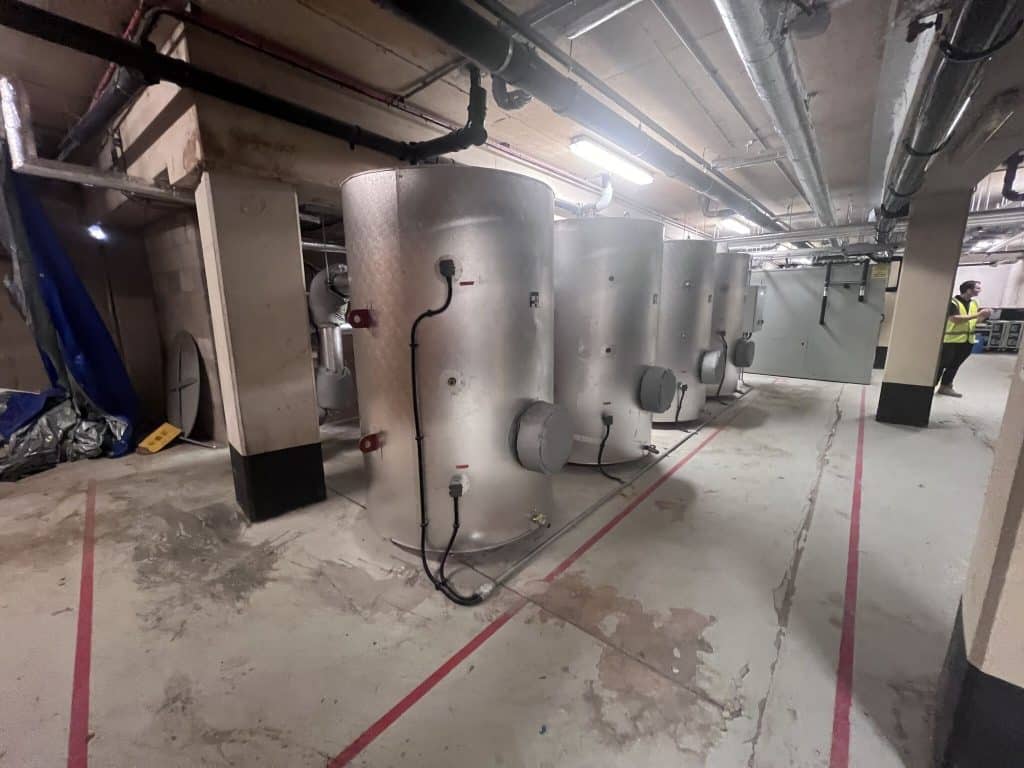
At Clade, we typically use a two-cylinder approach for domestic hot water.
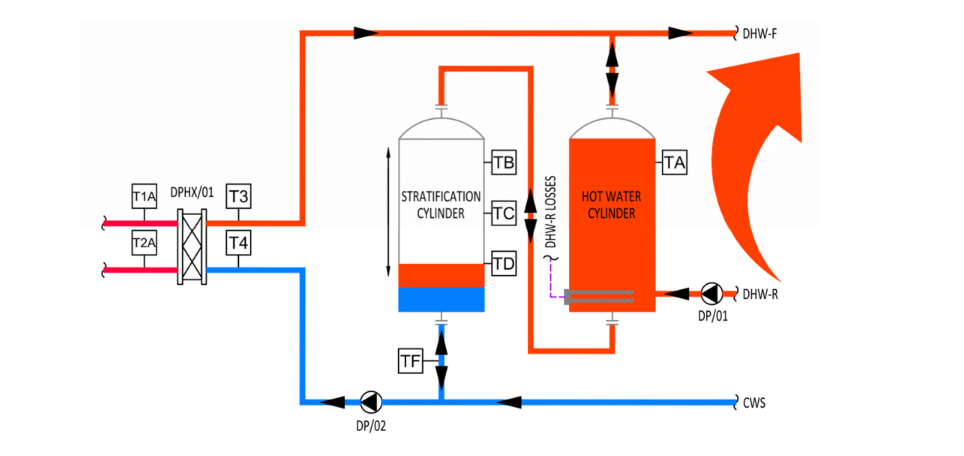
One cylinder is the hot water cylinder, which is maintained hot at all times, using direct electrical immersions.
The other is known as your stratification cylinder, which is separated into layers based on temperature, with hot water at the top and cold water at the bottom.
These two cylinders are connected and work together to make sure you always have hot water available to meet your needs.
When taps are turned on in your building, hot water leaves the top of the hot water cylinder to fulfil demand.
Meanwhile, the cold return water gets fed into the bottom of the stratification cylinder. This pushes the hot water at the top of the stratification cylinder into the bottom of the hot store cylinder, so that it’s ready to go when someone turns a tap back on.
Eventually, the stratification cylinder will fill up entirely with cold return water (while the hot water cylinder remains hot) – at which point, it’s time for your heat pump to get to work and raise the temperature of the cylinder, using the plate heat exchanger.
In this way, providing your cylinders have been properly sized, you should always have a steady supply of available hot water to meet the demands of your building instantly.
Enjoy instant hot water with a Clade-designed heat pump system
At Clade, our two-cylinder system for domestic hot water is there to ensure you always have a plentiful supply of hot water when you need it.
Our system designers will take the time to understand your hot water needs and schedules to design a system that’s properly sized and set up to meet your exact requirements.
Ready to see how an air source heat pump could meet your space heating and DHW requirements far more efficiently (and sustainably!) than a gas boiler?
Just get in touch to find out more.