Heat pumps are too difficult to get on-site: fact or fiction?
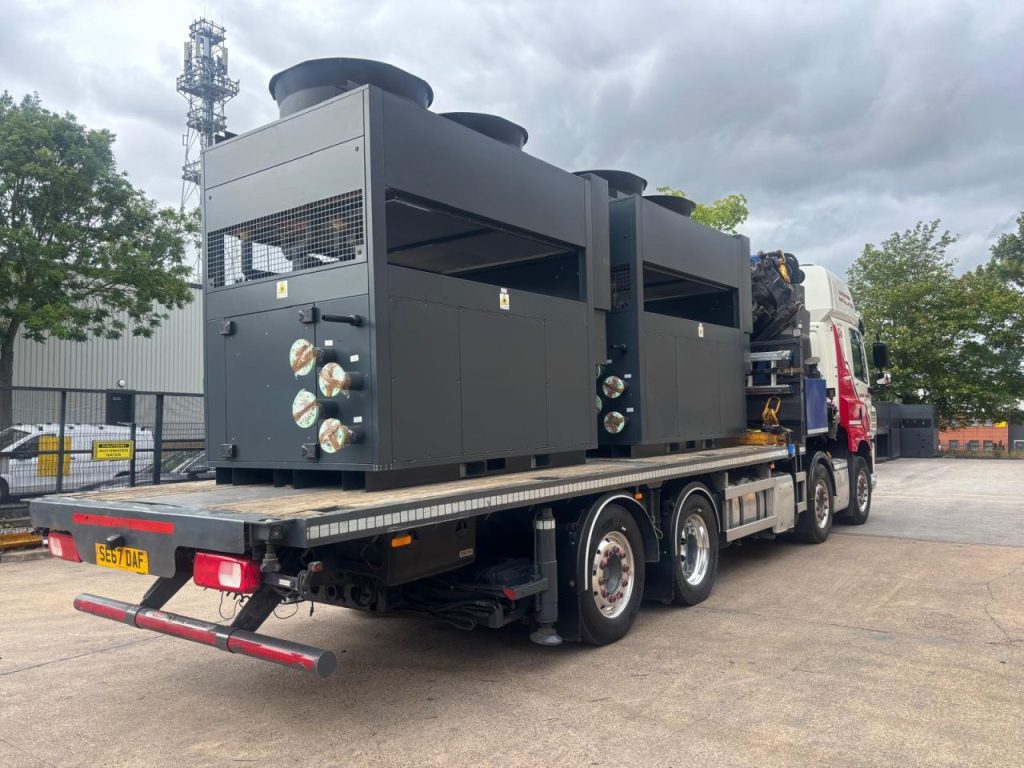
People often think that a heat pump will be too difficult to get on-site in retrofit projects.
It’s true that site access is an important consideration. But with careful planning and the right design, it’s rarely an insurmountable obstacle.
Here, we’ll explore the challenges and solutions of getting a heat pump on-site, before revealing our final verdict.
The challenge
Existing sites often weren’t designed with heat pumps in mind.
So, retrofit projects often involve working around space and access constraints.
You might be dealing with limited outdoor space or a tight city centre location with difficult access.
Or, if your project involves locating buffer tanks and controls indoors, you may have to deal with narrow doorways, corridors and stairways, as well as low ceilings and tight corners.
With this in mind, access certainly requires careful thought when it comes to getting plant like heat pumps and buffer tanks on-site.
But at Clade, we’ve retrofitted heat pumps in all kinds of buildings, ranging from historic buildings to tower blocks. And we’ve found that access is very rarely a deal breaker.
The solution
There’s a viable solution for nearly every project that has access challenges.
Here are some of the most common.
Modular systems
Modular or cascade heat pump systems can be a game changer for sites with difficult access.
Instead of one large commercial heat pump, the load is split across several smaller units, which can each be transported separately.
This makes the units easier to manoeuvre through restricted access routes. Plus, for constrained sites, they can be distributed across available space more flexibly.
Alternative installation locations
Considering alternative installation locations can also be a way to get around space or manoeuvrability issues.
Heat pump units require outdoor space but that doesn’t necessarily mean you need space in an existing service yard or plant area. You may be able to make use of unused car parking spaces or even rooftop space (as long as structural loading and maintenance access are considered).
Buffer tanks, meanwhile, can be located either indoors or outdoors – rooftops and basements are two popular choices.
Installation methods
Large equipment is installed on challenging sites every day. A heat pump is no different.
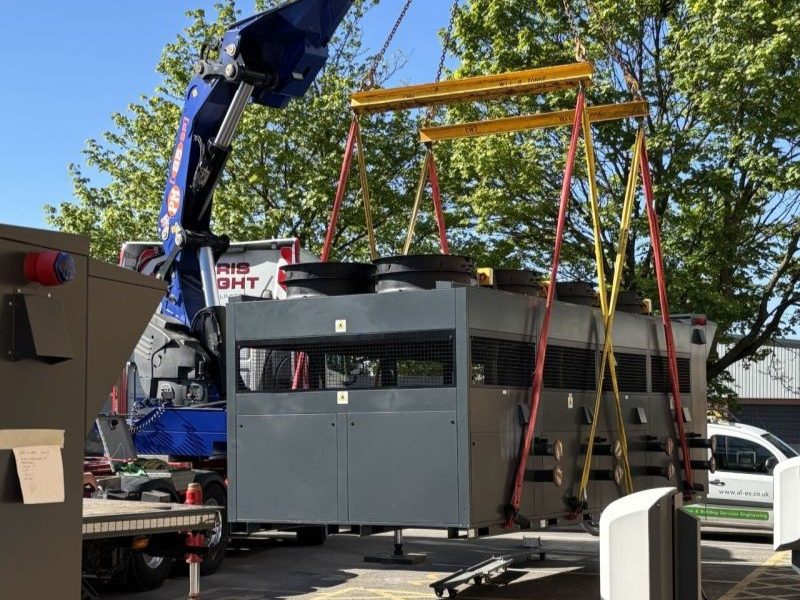
Specialist installation methods include using a crane to lift a heat pump over the building or through an alternative opening to reach a courtyard, loading bay or rooftop.
Another method is to temporarily remove doors or facade panels to create extra space for plant to gain access to its end location.
The key
As you can see, most access issues are manageable. The key is planning for these constraints as early as possible.
This includes:
- Conducting site surveys to identify access issues
- Measuring access routes
- Identifying lifting requirements
- Considering maintenance access as well as installation
- Collaboration between designers, manufacturers and installers
When access is considered early on, site constraints can be integrated in the heat pump system design from the offset.
This way, they never really become a logistical challenge. Instead, they’re just another design consideration to plan for.
The verdict
So, is it true that heat pumps are hard to get on-site?
Not necessarily!
While existing buildings can present access challenges, these are rarely insurmountable.
There’s a viable solution for almost every project – whether it’s modular systems, crane lifts or rooftop installation. The key is accounting for the challenges as early as possible, so that the system design can be developed around them.
At Clade, we design and manufacture heat pumps with real-world projects in mind.
Our Rowan 3 and Acer 2 heat pump ranges are modular systems made up of compact units, designed to fit into constrained spaces.
In this way, we help you more easily integrate low-carbon heating into both new build and retrofit applications, regardless of access.
Planning a project? Want to discuss the best heat pump solution for your site?
Just get in touch with your local senior sales engineer.